
Samba na Zona Sul [Samba in the South Zone]. (2004, February 11). IstoÉ, 67.
Translated from the original in Portuguese by Maria Claudia Oliveira
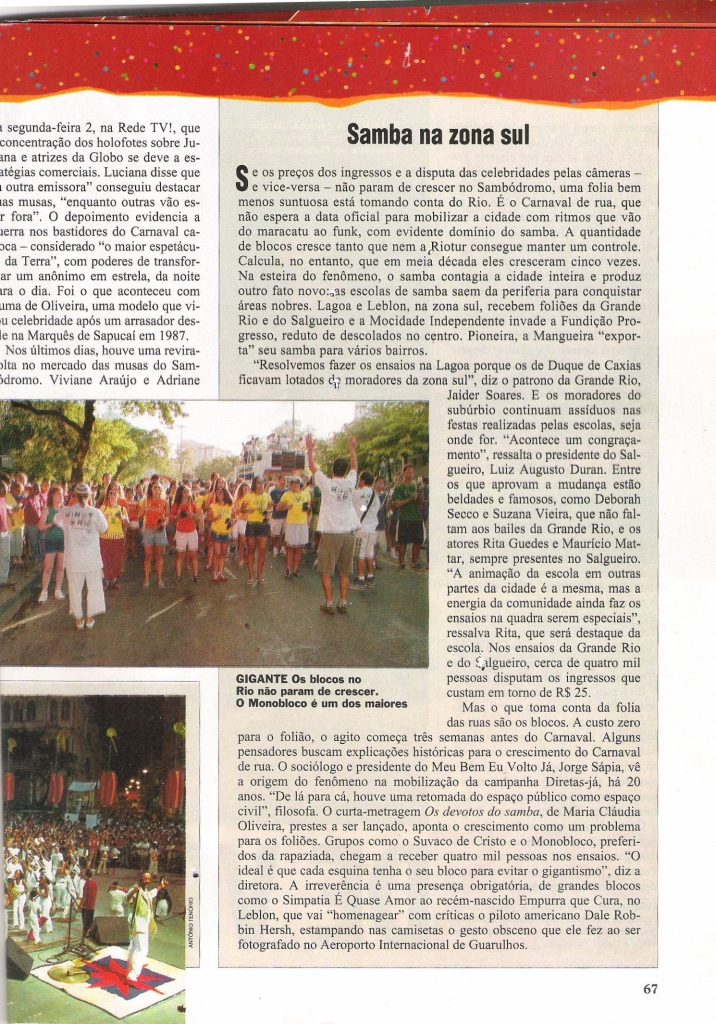
As ticket prices and celebrities’ competition for camera attention at the Sambadrome keep rising, a far less extravagant celebration is taking over Rio de Janeiro. Street Carnival doesn’t wait for the official dates to bring the city to life with rhythms ranging from maracatu to funk, although samba clearly dominates. The number of blocos (street Carnival groups) is growing so rapidly that not even Riotur, the city’s tourism agency, can keep track of them all. The agency estimates, however, that their number has increased fivefold in just half a decade.
Riding this wave, samba is spreading throughout the city, bringing about another new development: samba schools are leaving their traditional working-class neighborhoods to conquer Rio’s upscale areas. Lagoa and Leblon in the South Zone now welcome Carnival revelers from Grande Rio and Salgueiro, while Mocidade Independente has taken over Fundição Progresso, a popular downtown gathering place for the trendy crowd. A pioneer in this movement, Mangueira has been “exporting” its samba to several neighborhoods.
“We decided to hold rehearsals in Lagoa because our rehearsals in Duque de Caxias were packed with South Zone residents,” says Jaider Soares, Grande Rio’s patron. Meanwhile, suburban residents remain regulars at the samba schools’ parties, wherever they take place. “It brings people together,” emphasizes Salgueiro’s president, Luiz Augusto Duran.
Among those who welcome the change are beautiful women and celebrities, including Deborah Secco and Suzana Vieira, who never miss Grande Rio’s parties, and actors Rita Guedes and Maurício Mattar, frequent guests at Salgueiro’s events.
“The school’s enthusiasm is the same in other parts of the city, but the energy of the local community still makes rehearsals at the samba school’s headquarters special,” observes Rita, who will be one of the school’s featured performers in the Carnival parade. At Grande Rio and Salgueiro rehearsals, around 4,000 people compete for tickets costing approximately R$25.
But the blocos truly dominate the street celebrations. Free of charge for participants, the festivities begin three weeks before Carnival. Some observers seek historical explanations for the growth of street Carnival. Sociologist Jorge Sápia, president of the Meu Bem Eu Volto Já bloco, traces the phenomenon’s origins to the mass mobilization around the campaign for direct presidential elections 20 years earlier.
“Since then, public spaces have been reclaimed as spaces for civic life,” he reflects.
The short documentary Os Devotos do Samba (Devotees of Samba), directed by Maria Cláudia Oliveira and soon to be released, suggests that this growth is becoming a problem for Carnival revelers. Groups such as Suvaco de Cristo and Monobloco, favorites among younger crowds, attract as many as 4,000 people to their rehearsals.
“Ideally, there should be a bloco on every street corner to prevent these groups from becoming too large,” says the director.
Irreverence is essential to the festivities, from major blocos such as Simpatia É Quase Amor to the newly formed Empurra que Cura in Leblon. The latter plans to “honor” American pilot Dale Robbin Hersh with a dose of criticism, printing the obscene gesture he made when photographed at Guarulhos International Airport on its T-shirts.


You must be logged in to post a comment.