
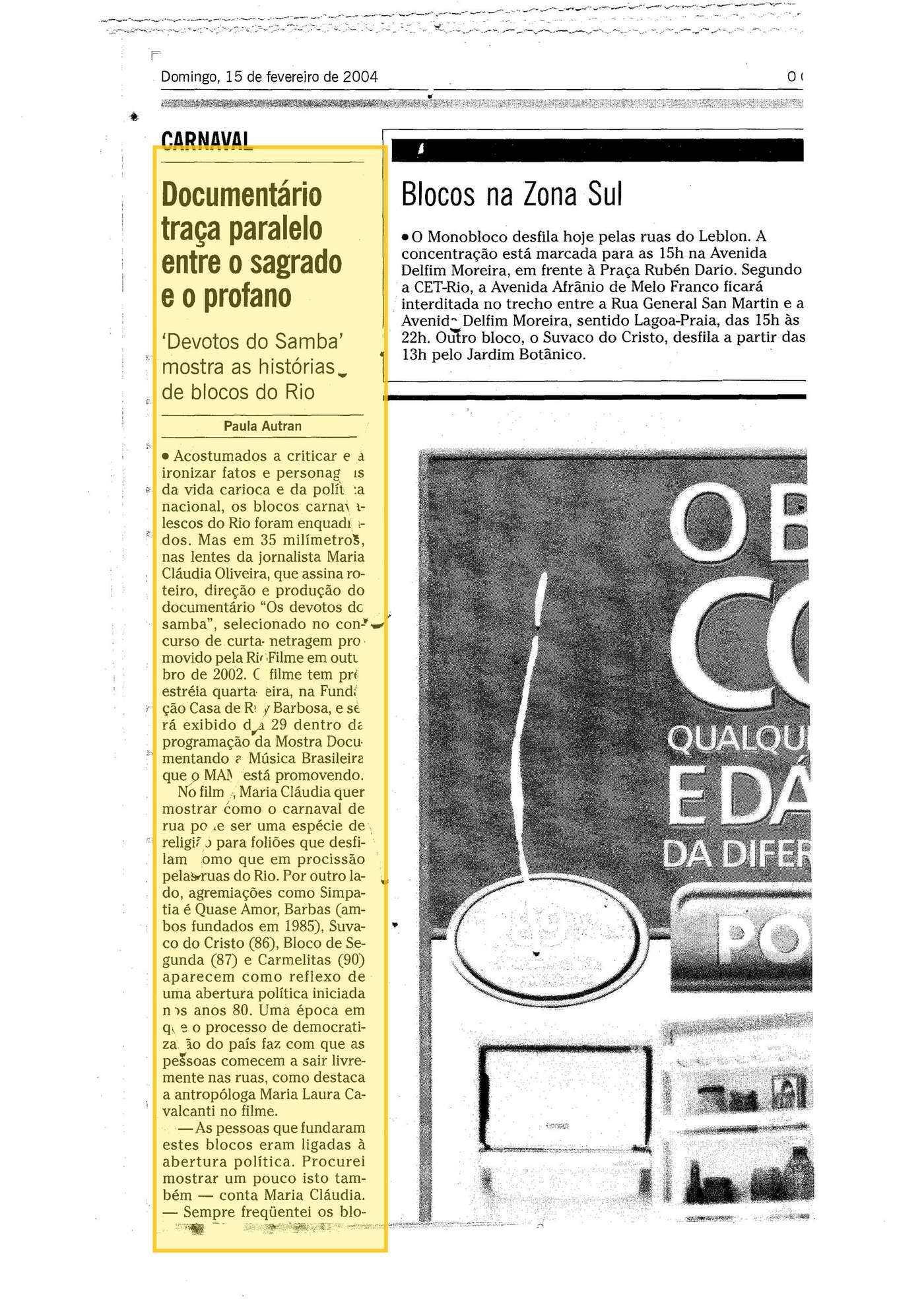
Documentário traça paralelo entre o sagrado e o profano
[Documentary draws a parallel between the sacred and the profane] (2004, February 15). O Globo, 3
By Paula Autran — O Globo, February 15, 2004
Accustomed to criticizing and poking fun at figures and events in Rio de Janeiro and national politics, the city’s Carnival street groups (blocos) have now been captured on film. In 35mm, through the lens of journalist Maria Cláudia Oliveira, who wrote, directed, and produced the documentary Os Devotos do Samba (The Devotees of Samba), selected in a short film competition organized by RioFilme in October 2002.
The film will have its premiere on Wednesday at the Casa de Rui Barbosa Foundation and will also be screened on the 29th as part of the Documenting Brazilian Music showcase organized by the Museum of Modern Art (MAM).
In the film, Maria Cláudia seeks to show how street Carnival can become a kind of religion for revelers who parade through Rio’s streets almost as if taking part in a religious procession.
At the same time, Carnival groups such as Simpatia é Quase Amor and Barbas (both founded in 1985), Suvaco do Cristo (1986), Bloco de Segunda (1987), and Carmelitas (1990) are portrayed as reflections of the political opening that began in the 1980s. It was a period when Brazil’s democratization process encouraged people to take freely to the streets, as anthropologist Maria Laura Cavalcanti points out in the film.
“The people who founded these Carnival groups were connected to the movement toward political openness. I tried to show some of that as well,” explains Maria Cláudia.
“I have always attended the Carnival street groups…”


You must be logged in to post a comment.